
As a DJ you've most likely spent years building your music library.
Thousands of tracks, bought track by track, imported from record pools, Beatport, and promo packs you barely remember agreeing to.
Somewhere along the way, the system you had to organise started feeling heavy, or if you never had a system, now the weight of thousands of unorganized tracks is sitting between you and every set you want to build.
The worst advice anyone gives about this problem is: start over. Delete everything and re-import clean. If you've been doing this for ten years, that advice ignores a decade of curation — tracks you found in the middle of the night, imports from a friend's hard drive, gems that don't exist anywhere online anymore. Starting over is not an option. Organizing is. Here's how to actually do it:
1. Accept That the Problem Is Navigation, Not Volume
Most DJs blame the size of their library for the problem. It isn't. It is that every single track is not easily discoverable and relies on your memory alone. Finding what you need, when you need it, without thinking too hard is priceless, but more or less impossible when you've realistically reached over 300+ tracks.
Before you touch a single file, get clear on what navigation actually means to you. When you're prepping a set, what questions are you trying to answer? You might be asking:
- What do I have that fits this energy level?
- What tracks work well with this particular opener?
- What haven't I played recently that's worth revisiting?
Your organization system should answer those questions. Not all organization systems do. Alphabetical folders, genre folders, BPM folders ignore the fact 2 tracks can feel world appart and still we force them fall into one category, and even when you awknowledge this nuance, you would still end up with duplicate tracks in all your folders.
2. Stop Reorganizing. Start Layering.
The mistake most DJs make is trying to rebuild their folder structure from scratch; moving files, creating new folders, reconstructing playlists. This takes weeks, it's exhausting. And, by the time you're done, your library has already grown again and the structure is outdated
The better approach is layering: adding organizational metadata on top of the files you already have without moving anything.
In Rekordbox, this means colour coding for energy level (not genre), star ratings for quality or confidence, using the comments field for context like "works for warm-up" or "peak time only", and setting up My Tags for custom categories.
Within Djoid, everything happens automatically — Djoid analyzes your tracks, assigns danceability, energy, key, emotion, BPM, cue points, genre, automatically.
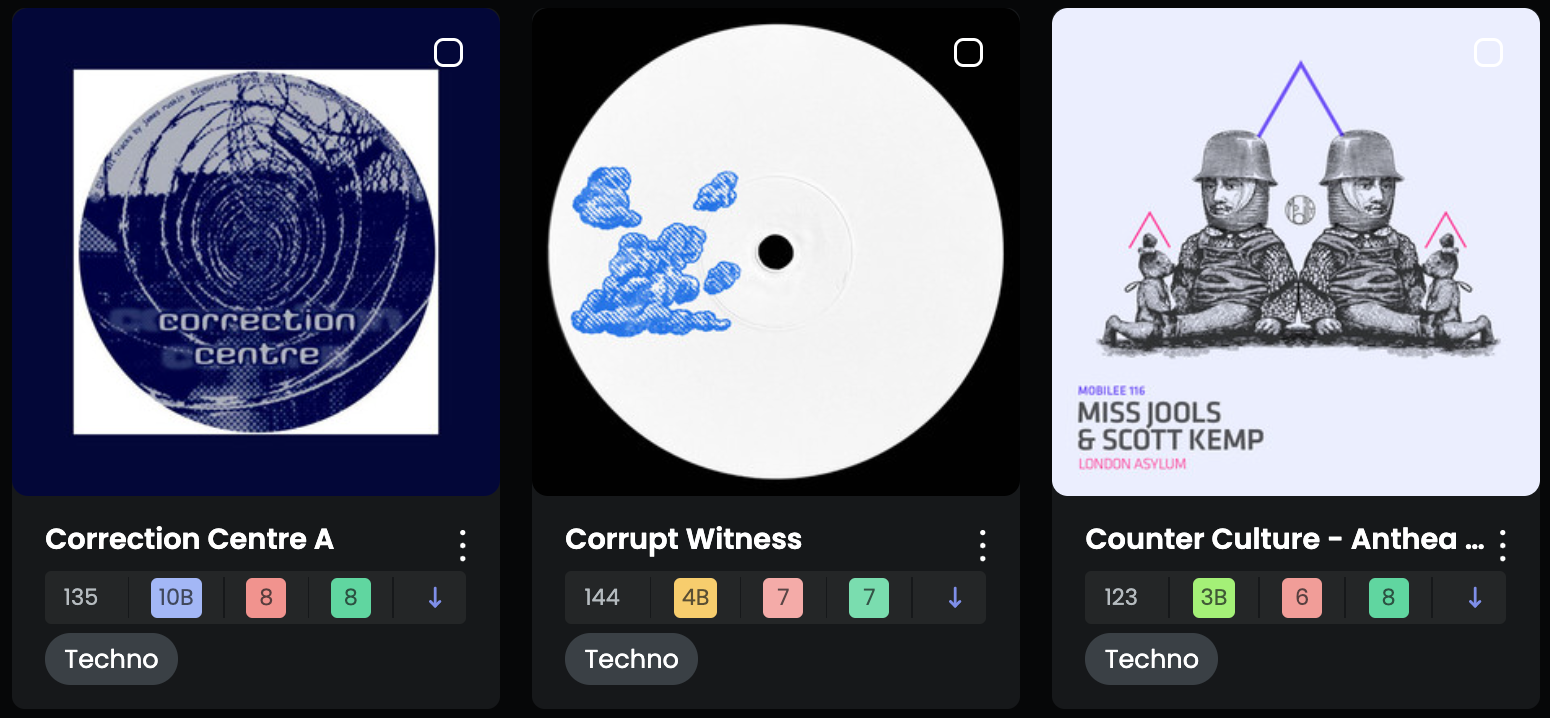
Sample of Djoid tracks
3. Build a System That Works in the Booth, Not Just at Home
The test of any organization system is not how it looks on your laptop. It's how fast it works when you have three minutes to find the right track and a room full of people waiting.
Booth-ready organization has three qualities:
1. It's navigable without reading
You should be able to feel your way around your library. Color codes help. Track collections/crates that describe and contain energy ("Openers", "Peak Time", "After Hours") help. Alphabetical folders of 10,000 tracks do not.
2. It's current.
If you download 50 tracks this week and they sit untagged in a folder called "NEW - May 2026" for six months, your system isn't current. You need a weekly 20-minute maintenance habit, not an annual reorganization project.
3. It surfaces what you've forgotten.
Any organization system that only shows you what you already know you have is incomplete. It's impossible for a DJ with hundreds of tracks to perfectly remember all of them. If you can't access and use most of your music, what was even the point in even downloading them? Great tracks that never surface, not found nor played?
4. Use the Right Tool for Each Job
Different tools solve different problems. Using only Rekordbox for everything is like using only a hammer for every job in your house. It works, but not well, and you might some holes in the wall here and there.
Here's a practical breakdown:
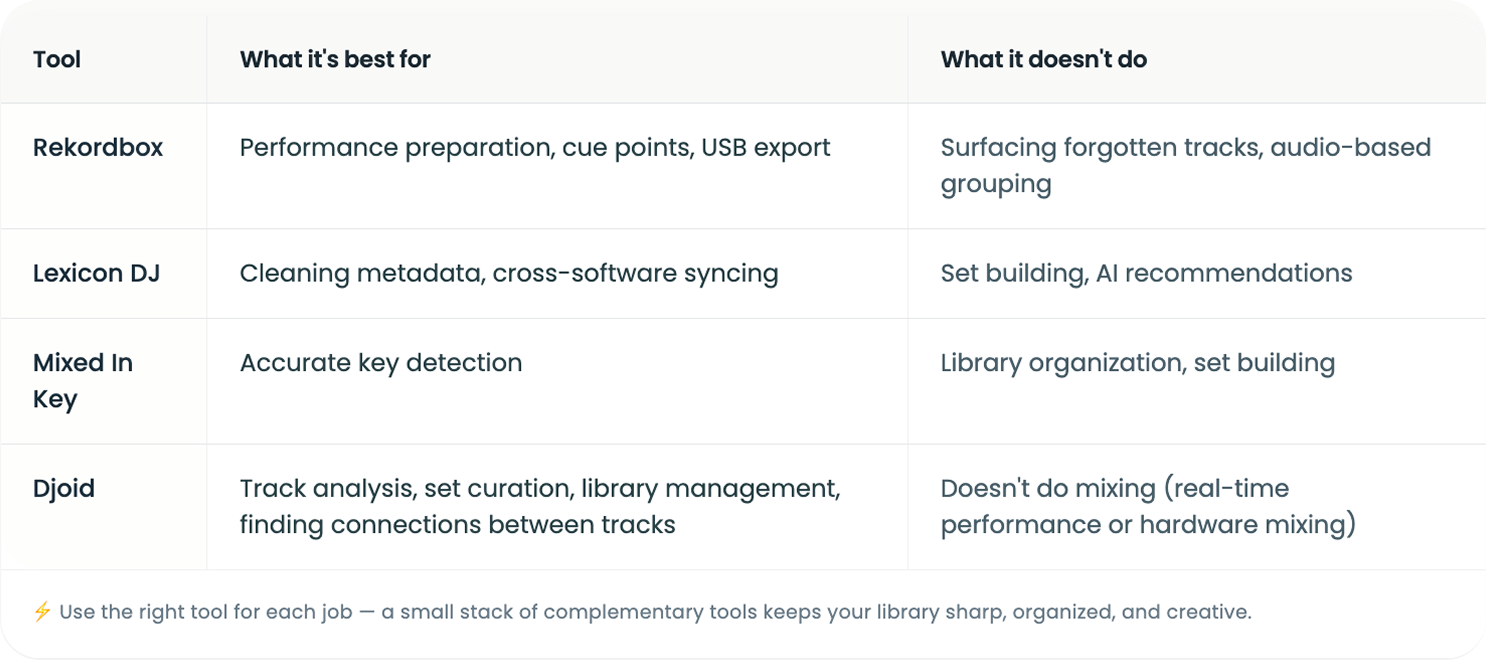
The mistake is expecting one tool to do everything. The DJs with the most organized libraries use a small stack of complementary tools. Each one does one thing very well.
What a Good Music Library Actually Looks Like
A well-organized DJ library isn't a perfectly tagged flat file system. It's a library you can navigate in under two minutes to find the right track for any moment.
It's a collection where new tracks get processed and placed within a week of downloading. It's a system where your oldest, most interesting music stays visible — not buried under the weight of everything you've imported since.If your current setup doesn't do that.
Build the habit of maintenance. Do it again next month. Over six months, a 10,000-track library that felt overwhelming becomes a 10,000-track library that feels like a creative asset.
.gif)
With Djoid, you are able cut down this extenuating, never ending, library maintenance and orgranisation process and bring it to a manageable level. It doesn't just speed up the work; it transforms an exhausting, never-finished chore into an easy process.
Your library stays clean, your oldest tracks stay findable, and you stay behind the decks instead of buried in folders. That's not just a better workflow. That's the difference between a library that fights you and a library that works for you.